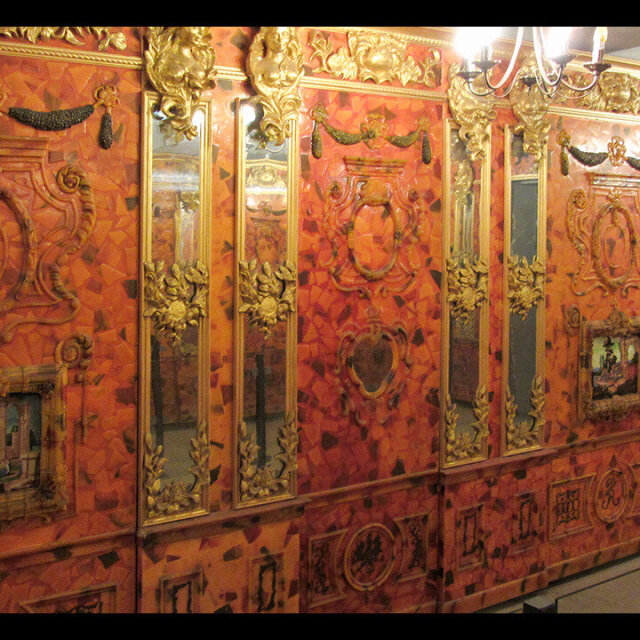

The Amber Room, Mamerki, Poland The Amber Room, measuring 10.5m x 11.5m, was created in the early 18th century at the initiative of Frederick I of Hohenzollern. It was intended to decorate his study in the Charlottenburg Palace near Berlin. The architect Andrzej Schluster from Gdańsk is considered the creator of the artistic concept of the Amber Room. In 1716, Tsar Peter I of Russia, during a visit to Potsdam, was delighted with the masterpiece and received it as a gift from Frederick William I as a token of friendship and confirmation of the alliance. The gift was sent to St. Petersburg. The Amber Room was displayed in the Summer Palace, then the Winter Palace, and finally, in 1755, at the behest of Elizabeth I, it was moved to Tsarskoye Selo. There, it was expanded and enriched. In 1941, the palace was looted by the Germans. The Amber Room was transferred to Königsberg Castle. On April 9, 1945, the Red Army captured Königsberg, but the treasure was never found. One of the hiding places of the Amber Room, identified by Erich Koch (Gaulaiter of East Prussia), was Mamerki. Polish sappers conducted searches in the 1960s and again in the 1970s. In 2016-2017, the search for the Amber Room was renewed in Mamerki. International and national media reported live on the search. The treasure has not yet been found. In the photo - a replica of a fragment of the wall made of artificial amber. :) #bursztyn #bursztynowakomnata #komnata #mamerki #polska #amber #amberroom #room #skarb #treasure #poland #museum #muzeum #wwii #history #historia
snapstories
The construction of the replica based on historical photos has been completed (not my photo)