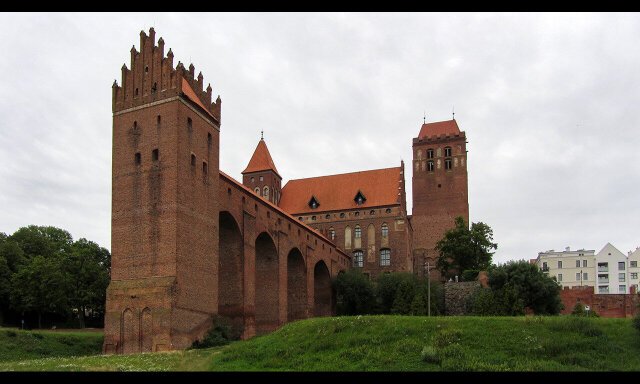

The Castle of the Pomesanian Chapter, Kwidzyn, Poland (part 1 of 2) Construction began at the turn of the 13th and 14th centuries. Most of the construction work on the castle was completed in the years 1340–1350, and in the 1380s, dansker was completed. Initially, the castle was an independent structure, and only later was it connected to the cathedral, and its south-eastern corner tower was transformed into a bell tower. The completion of the new cathedral church is dated to the period of Bishop Jan Mönch’s rule (1377–1409). At that time, a unique architectural complex was created in Kwidzyn, which included two castles (bishops’ and chapters’), the cathedral and the town. The individual sections had their own fortifications, and connected by walls, they created a defensive system perfectly integrated into the natural conditions of the area. The castle became the seat of the Pomesanian chapter, as well as a religious and political-administrative center. Under the provisions of the Second Peace of Toruń, Kwidzyn, together with the bishop’s dominion, was granted to the Teutonic Order. In 1478, Polish troops captured Kwidzyn. The townspeople took refuge in the chapter’s castle and set fire to the town. During the war, the castle was seriously damaged – during renovation works carried out in 1487, the damaged corner towers were demolished. In 1520, as a result of further military operations, Polish troops completely destroyed the bishop’s castle and most likely damaged the chapter castle. [continued in comment] #kwidzyn #zamek #castle #gdanisko #dansker #kapitula #chapter #biskupstwo #bishopric #polska #poland #historia #history #architecture #architektura #gothicarchitecture #gothic #widok #landscape #krajobraz #krzyzacy #zakon #teutonicorder #teutonicknights #knights #rycerze #walls #wall #mury #mur
snapstories
In 1526, the Pomesanian bishops converted to Protestantism. In the 1530s, the first Protestant bishop, Paulus Speratus, carried out renovations of the chapter castle at his own expense. After his death, in 1551, the castle was taken over by officials of Prince Albrecht Hohenzollern, becoming a government building and residence. In 1728, the southern wing of the castle was transformed into a food warehouse for the military garrison. After the first partition of Poland, the castle became the seat of the court. Due to the change in function, necessary adaptation works were carried out. Part of the castle was adapted for prison purposes. In 1798, a decision was made to demolish two castle wings: the eastern and the most representative southern, in order to build a separate building from the acquired material. After 1854, by order of King Frederick William IV, the devastation of the castle was stopped and reconstruction work began. The corner towers were rebuilt, the vaults in the rooms on the first floor of the northern wing were reconstructed and the architectural detail was supplemented. The castle served as a court and prison until 1935. In 1936, after a series of adaptation works, the castle became the seat of the Hitlerjugend HJ-Ostlandführerschule Nazi school and served this function until 1945. After the city was occupied by the Red Army, the castle - unlike the Old Town - fortunately avoided major damage, only its interiors were plundered. In December 1949, the castle was taken over by the Polish Ministry of Culture and the Arts.